XREAL Aura
The 95-gram glasses run Google Play games on a 70-degree screen, take a $99 controller and mirror a handheld or PC over one USB-C cable.
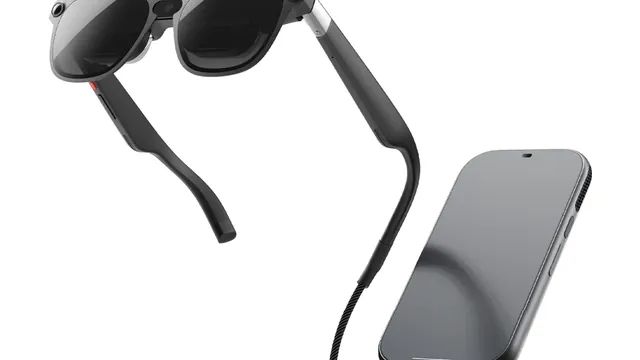
XREAL Aura is the first pair of glasses that runs Google's Android XR, and it costs $1,099 in the US through the end of 2026, $180 below its $1,279 list price. That buys the 12GB model with 256GB of storage; the 16GB, 512GB model is $1,299 instead of $1,499. The glasses weigh 95 grams, put a 70-degree virtual screen in front of you while you can still see the room, and plug by cable into a phone-sized compute puck that runs Google Play apps and games. Orders opened on October 28, 2026, at XREAL's own store and Best Buy, and Google says shipments begin in mid-November, in batches.
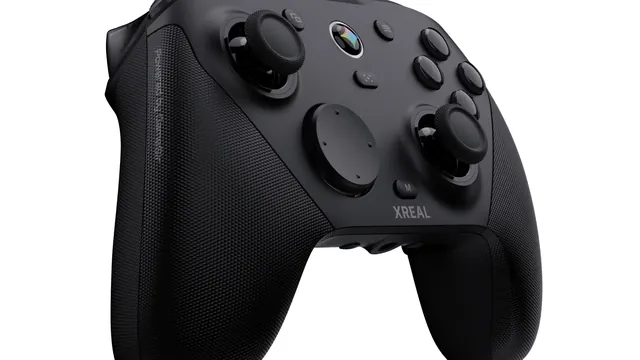
For gamers the pitch is a big private screen that fits in a jacket pocket. Aura plays thousands of Android games from Google Play, mirrors a gaming handheld or a laptop through a USB-C cable, streams from a PC or console, and runs a small but growing set of games built for the glasses, played with your hands. XREAL sells a $99 controller with an Xbox-style layout to go with it.
XREAL Aura price and bundles
XREAL cut Aura's price on launch day. The glasses were first listed at $1,279 and $1,499, and XREAL now calls $1,099 and $1,299 a limited-time launch offer that runs through the end of the year. Anyone who paid the original price gets the difference back: $180 on the 12GB model and $200 on the 16GB model, according to XREAL's Aura page.
Each memory size comes in two frame sizes, M and L, set by your interpupillary distance (IPD), the distance between the centers of your pupils. Pick the wrong one and XREAL warns of blurry edges and a cut-off image.
| What you buy | Launch price | List price |
|---|---|---|
| XREAL Aura, 12GB and 256GB | $1,099.00 | $1,279.00 |
| XREAL Aura, 16GB and 512GB | $1,299.00 | $1,499.00 |
| Gaming Bundle, with the controller | $1,198.00 or $1,398.00 | $1,378.00 or $1,598.00 |
| Productivity Bundle, with the keyboard | $1,178.00 or $1,378.00 | $1,358.00 or $1,578.00 |
| All-in-One Bundle, controller and keyboard | $1,277.00 or $1,477.00 | $1,457.00 or $1,677.00 |
| XREAL Game Controller, on its own | $99.00 | $99.00 |
| XREAL Keyboard, on its own | $79.00 | $79.00 |
| Prescription lenses | $49.90 to $69.90 | $149.90 to $169.90 |
The bundles save nothing over buying the pieces separately at launch prices: the Gaming Bundle is exactly the glasses plus the $99 controller. They do put everything in one order and one shipment.
XREAL Aura release date and shipping
Aura went on sale on October 28, 2026, the day Google announced the launch on its blog. Orders opened that day in the US, Canada and South Korea, and in Japan on November 2. In the US you can order from xreal.com or BestBuy.com.
Google's launch post gives mid-November for the first shipments, and XREAL's US store says the glasses go out in batches. Orders go out in priority groups that favor buyers who reserved before launch, though XREAL says a priority place doesn't guarantee a spot in the first batch or a set delivery date. Tracking arrives by email when an order leaves XREAL's US warehouse. So an order placed this week may not land in the first wave.
What XREAL Aura is: glasses plus a puck
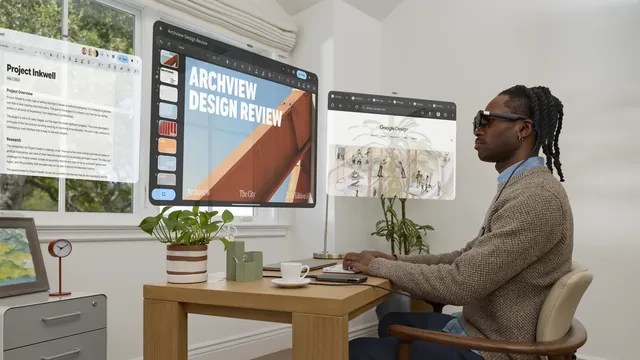
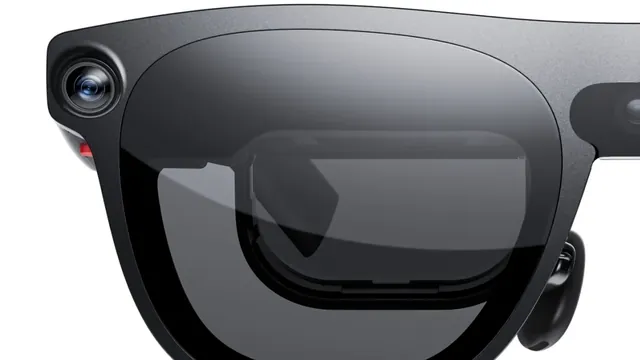
Aura splits the work in two. The glasses hold the displays, the cameras, the speakers and a small XREAL chip, the X1S, which keeps the picture locked in place as your head moves, with 3 milliseconds from movement to updated image. Everything heavy sits in the puck: Qualcomm's Snapdragon Reality Elite chip, which makes its debut in Aura, the memory, the storage and a 4,455 mAh battery. The puck weighs 265 grams, has a fan, and doubles as a trackpad.
The lenses are optical see-through, meaning you look at the real room through clear glass rather than at a camera feed of it, as you do in a VR headset. Content is drawn on top. Electronic dimming darkens the lenses in five steps for a movie or a game, and Google says they turn clear again when someone comes into view.
Two cameras on the frame track the room and your hands, so windows stay where you put them, which is called six degrees of freedom (6DoF) tracking: the glasses follow both where you look and where you move. A third, higher-resolution camera feeds Gemini, Google's assistant, when you ask it about what you see. A privacy light shows when it is on.
On the software side, Aura runs Android XR, the system Google built for headsets and glasses. Google says it brings millions of Google Play apps and more than 150 apps made for XR. You can open several apps at once and arrange the windows around you, and Gemini can answer questions about anything on screen or in the room.
Can you play games on XREAL Aura?
Yes, in four ways, and only one of them needs games made for the glasses.
- Android games from Google Play. Aura is an Android device, so the phone and tablet games you already know run on a floating screen. Google puts the number in the thousands. Games that support a controller play best, since touch controls don't translate to glasses.
- A handheld or PC over a cable. Google calls it Wired Mirroring: plug a device into the puck's second USB-C port with a cable that carries video, and its screen shows up as a window you can resize and place anywhere, with nothing to install. The port accepts DisplayPort over USB-C, the same video signal a gaming handheld such as the ROG Xbox Ally X20 sends to a monitor.
- Streaming. XREAL's controller listing names playing in the cloud and streaming from a PC or console. If you get stuck, Google says you can ask Gemini for help without putting the controller down.
- Games built for XR. These sit in your room and are played with your hands. Google names studios such as Owlchemy Labs and Resolution Games, whose co-op dungeon crawler Demeo plays across headsets and flat screens. New games arriving with Aura include Fallout: Factions, a squad battle game based on the Fallout tabletop game, and Project Hail Mary: Journey Among the Stars, made with Amazon MGM Studios.
Google adds a spatial view that turns almost any video, photo or game into 3D with a tap. You can also keep a walkthrough video or a chat open next to the game.
Aura isn't a VR headset, and neither XREAL nor Google pitches it as one. The 70-degree view is wide for glasses but narrower than a headset's, and games are laid over the real room rather than replacing it.
The XREAL Game Controller
The $99 controller is XREAL's own, built with the controller maker GameSir, whose name is printed on the grip. XREAL describes it as an Xbox layout with TMR sticks and Hall effect triggers. TMR, short for tunnel magnetoresistance, and Hall effect both read position with magnets instead of parts that rub together, which is meant to stop stick drift, the slow wandering a worn stick develops.
You don't have to buy it. The puck pairs with Bluetooth keyboards, mice and game controllers, so a controller you already own should connect as it would to an Android phone. XREAL also sells a $79 foldable Bluetooth keyboard with shortcut keys for Android XR.
XREAL Aura specs
| Part | XREAL Aura |
|---|---|
| Displays | Sony micro-OLED, 1920 x 1200 pixels per eye |
| Field of view | 70 degrees |
| Refresh rate | Up to 120Hz |
| Brightness | Up to 1,050 nits |
| Sharpness | 32 pixels per degree |
| Tracking | Two world-facing cameras, 6DoF, hand tracking |
| Camera | High-resolution RGB camera with a privacy light |
| Audio | Open-ear speakers tuned by Bose, four microphones |
| Lens dimming | Five levels, automatic or manual |
| Frame sizes | M for IPD 60-66 mm, L for IPD 66-72 mm |
| Glasses weight | 95 grams |
| Puck chip | Snapdragon Reality Elite, 48 TOPS of AI processing |
| Memory and storage | 12GB and 256GB, or 16GB and 512GB |
| Battery | 4,455 mAh, 34.84 Wh, in the puck |
| Ports | USB-C for the glasses, USB-C for charging and video in, up to 57 W |
| Wireless | Wi-Fi 6 and 6E, Bluetooth 5.3, GPS |
| Puck weight | 265 grams, with a fan |
The micro-OLED panels come from Sony, and XREAL says each pair is color-calibrated at the factory. A fingerprint button on the puck locks the system and approves app purchases. Three nose pad sizes ship in the box, and the temples flex to fit different heads.
XREAL hasn't published a battery life figure for Aura. Since the puck charges over USB-C at up to 57 watts, a power bank or wall charger can keep it going during a long session.
XREAL Aura vs other XREAL glasses
Aura is XREAL's most expensive pair, and the only one with its own computer and app store. XREAL's other glasses work as displays: they show what a phone, handheld, console or PC sends them, and they cost far less. On XREAL's own lineup page the XREAL One Pro is listed at $599 and the ROG XREAL R1, made with Asus for gaming, at $849.
| XREAL Aura | ROG XREAL R1 | XREAL One Pro | |
|---|---|---|---|
| Price on XREAL's site | From $1,099.00 | $849.00 | $599.00 |
| Weight | 95 grams | 91 grams | 87 grams |
| Field of view | 70 degrees | 57 degrees | 57 degrees |
| Top refresh rate | 120Hz | 240Hz | 120Hz |
| Tracking | 6DoF | 3DoF | 3DoF |
| Peak brightness | 1,050 nits | 700 nits | 700 nits |
| Runs apps by itself | Yes, Android XR on the puck | No, needs a source device | No, needs a source device |
If all you want is a giant screen for a handheld, a display-only pair does that job for less, and the R1's 240Hz mode suits fast shooters. Those pairs track only where you turn your head (3DoF), so a window can't stay pinned to a spot in the room the way it does on Aura. Aura makes sense if you want the glasses to work on their own, with Google Play, a browser and streaming apps, and also to take a cable from your handheld or laptop when you want it.
Is XREAL Aura worth it for gaming?
Aura is a first-generation product on a new platform, and its price reflects that. At $1,099 it costs about as much as a high-end gaming handheld, and it doesn't replace one: the best games you can play on it still come from Google Play, a stream or a cable. What it adds is the screen. A 70-degree view at 1,050 nits, pinned in place, turns a plane seat or a bed into a big-screen setup, and the puck lets it work without a phone or a laptop in the loop.
Three groups get the most from it. Handheld and laptop owners who want a bigger screen on the road gain a display that also runs its own apps. Android gamers who already play with a controller get a private theater for those games. And people curious about mixed reality who don't want a headset on their face get the lightest way in, with hand-tracked games that sit in the room.
If you're weighing it against what comes next, Meta showed its own VR Glasses at Connect 2026, and Samsung and Google have display-free smart glasses on the way at a much lower price. For the longer view of where glasses and headsets are heading, see our look at how VR will look in 2030.
The launch price is the one hard deadline. XREAL says the $1,099 and $1,299 prices hold through the end of 2026; it hasn't said what happens after that, but the list prices of $1,279 and $1,499 are already on its store.
FAQ
Do I need a phone to use XREAL Aura?
The glasses run on their own compute puck, which holds the battery, the Snapdragon chip, Wi-Fi and the Android XR system, so a phone isn't required. Apps and games install from Google Play straight onto the puck.
Can I use XREAL Aura with glasses or a prescription?
XREAL sells prescription inserts made for Aura, at $49.90 to $69.90 during the launch offer, depending on the lens index and whether you want blue light blocking.
Who can buy XREAL Aura?
Google lists the glasses for users 18 and older. Orders are open in the US, Canada, South Korea and Japan; XREAL hasn't scheduled other countries.
Add VR.one as a preferred source on Google and our stories show up more often in your Top Stories.