Samsung Odyssey G6
The world's first 1,100Hz monitor splits its speed between two modes, and only a high-end PC can feed the fast one.
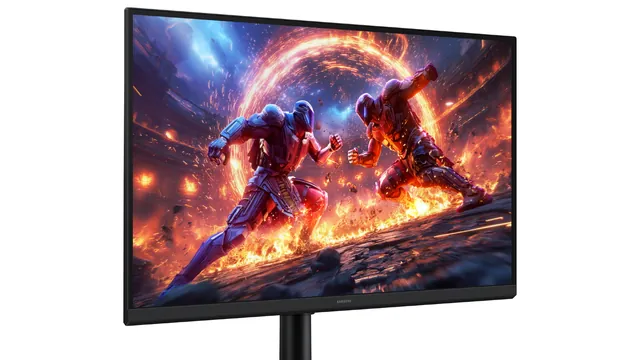
The Samsung Odyssey G6 is a 27-inch gaming monitor that refreshes up to 1,100 times a second, the first gaming monitor to reach that speed, and it goes on sale at US retailers nationwide beginning in December 2026 for $899.99. Samsung announced the US launch of the model, called G60H, on November 23, 2026. The headline number comes with a catch: the monitor hits 1,100Hz only at HD resolution, while its sharper QHD mode tops out at 600Hz.
Samsung calls the switch between the two Dual Mode. In HD the G6 chases raw speed for fast shooters; in QHD, 2,560 x 1,440 pixels, it trades some of that speed for a cleaner picture in bigger, slower games. Either way it's one of the fastest screens anyone can buy, and it raises a practical question for most players: what can actually send it that many frames?
How much is the Samsung Odyssey G6 and when does it come out?
Samsung lists the Odyssey G6 at $899.99 in the US. The company says it will roll out at retailers nationwide beginning in December 2026, without naming a day or a list of stores. Samsung's US store didn't list the G60H when we checked on November 25, 2026, so there's no pre-order button on its site yet.
The price puts the G6 in premium territory for a 27-inch LCD. Samsung's earlier 27-inch Odyssey G6, the G60F, runs QHD at up to 350Hz, and the new model raises that ceiling by more than 70% at the same resolution. For the extra money you are buying speed, not size: the G6 is still a 27-inch IPS screen, the LCD technology known for wide viewing angles.
Samsung's own announcement also points shoppers toward holiday pricing on the rest of its monitor lineup, which is available now. The G6 itself isn't part of that, since it hasn't reached stores.
| Detail | Samsung Odyssey G6 (G60H) |
|---|---|
| US price | $899.99 |
| US availability | Retailers nationwide, beginning in December 2026 |
| Announced for the US | November 23, 2026 |
| First shown | Ahead of CES 2026, as a 1,040Hz model |
| Final spec revealed | Gamescom 2026, August 27, 2026 |
What does 1,100Hz mean on a monitor?
Refresh rate is how many times per second a screen draws a new image. A typical TV or office monitor refreshes 60 times a second, and most consoles top out at 120. At 1,100Hz, each image stays on the G6's screen for about 0.91 milliseconds before the next one replaces it. At 600Hz in QHD it's about 1.67 milliseconds, and at 120Hz about 8.33.
More images per second means smoother motion and a picture that reflects what's happening in the game a little sooner. That matters most in competitive shooters, where you track a target that crosses the screen in a fraction of a second. Samsung pitches the G6 at exactly those players, describing it as built for fast-paced games where you need to follow movement and react quickly.
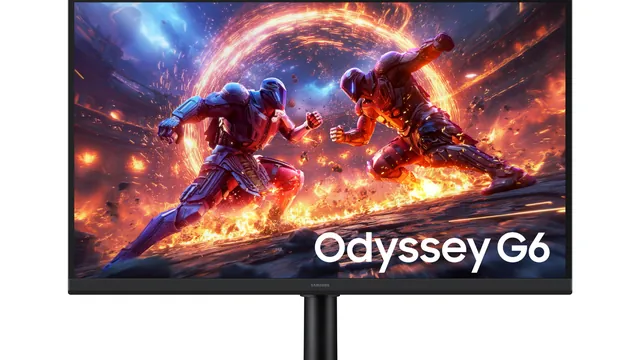
Speed alone doesn't make motion clear. Pixels need time to change color, and Samsung rates the G6 at 1ms gray-to-gray, a measure of how fast a pixel shifts from one shade of gray to another. Samsung's footnote explains that 1ms is an average somewhere between 1.00 and 1.99 milliseconds, rounded down, measured in the monitor's Extreme mode. On those figures, an average pixel change can take longer than one frame lasts at 1,100Hz.
That is where Odyssey Clear Motion comes in. It's a new blur reduction feature, an algorithm that Samsung says keeps fast-changing scenes crisp during critical moments. The G6 is the first monitor to get it, and Samsung plans to bring it to more gaming monitors later.
How Dual Mode works on the Odyssey G6
Dual Mode is Samsung's name for switching resolutions to unlock a higher refresh rate. You don't flip a hardware switch; you change the resolution, and the monitor moves to the matching speed.
| Mode | Resolution | Top refresh rate | Time per frame |
|---|---|---|---|
| QHD | 2,560 x 1,440 | 600Hz | About 1.67 ms |
| HD | Samsung lists it as HD | 1,100Hz | About 0.91 ms |
Samsung's examples are simple: use QHD for an immersive open world, HD for quick action. In practice HD is the competitive-shooter mode. Fewer pixels per frame makes it far easier for a graphics card to produce frames fast enough, and in fast games many players already lower settings to raise frame rates.
The trade-off is sharpness. Text and fine detail look softer at HD on a 27-inch screen than at the panel's native QHD, so the fast mode is a tool for matches, not for everyday desktop work.
Samsung Odyssey G6 specs
| Spec | Odyssey G6 (G60H) |
|---|---|
| Screen | 27-inch class, flat IPS |
| Native resolution | QHD, 2,560 x 1,440 |
| Refresh rate | Up to 600Hz in QHD, up to 1,100Hz in HD |
| Response time | 1ms gray-to-gray (Extreme mode) |
| Variable refresh | Nvidia G-Sync Compatible, AMD FreeSync Premium |
| HDR | HDR10+ Gaming |
| Ports | One DisplayPort 2.1, two HDMI 2.1 |
| Stand | Height, tilt, swivel and pivot adjustment |
| Extras | Odyssey Clear Motion, Black Equalizer, Auto Source Switch+ |
A few of these deserve a plain explanation. G-Sync Compatible and FreeSync Premium are variable refresh, meaning the monitor matches its refresh to the frames the graphics card sends, which cuts tearing and stutter. HDR10+ Gaming adjusts brightness and contrast on the fly in games that support it. Black Equalizer brightens dark areas so enemies in shadow are easier to spot, and Samsung says it adapts to the game genre automatically. Auto Source Switch+ jumps to a device the moment you plug it in, so you don't cycle through inputs by hand.
What PC do you need to run the Odyssey G6 at 1,100Hz?
Samsung's footnotes set the limits more clearly than its headline. The monitor's refresh rate "may vary based on supported game content and input source performance," which is a polite way of saying your PC and your game decide what you actually see.
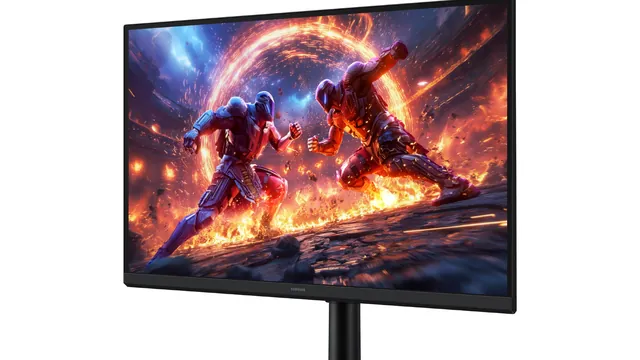
Three details stand out for PC players:
- AMD cards. FreeSync Premium doesn't work at 1,100Hz, and Samsung says AMD Radeon RX 6000 series cards and older don't support refresh rates of 1,000Hz or more at all.
- HDR10+ Gaming. It runs over HDMI 2.1 on Nvidia and Intel graphics cards, and only in specific games.
- Mac. macOS supports neither Dual Mode nor the 600Hz native maximum.
The ports matter too. DisplayPort 2.1 is the newest version of the connection most PC gamers use, built for very high resolutions and refresh rates, and the G6 has one. The two HDMI 2.1 ports are the natural home for consoles.
Then there's the game. A monitor can only show frames the PC renders. Competitive shooters with light graphics can run at many hundreds of frames per second on a fast system with low settings; big open-world games usually can't come close. Technologies that generate extra frames, such as Nvidia's DLSS, help close that gap in supported games, and our DLSS 5 games list tracks which titles have it. For most players the 600Hz QHD mode will be the one they use day to day.
Is the Odyssey G6 good for PS5, Xbox and Switch 2?
It works with all three over HDMI 2.1, but no console comes anywhere near its top speeds. Each one caps out at 120 frames per second, and only in games built for it.
| Console | Top frame rate | What the G6 adds |
|---|---|---|
| PS5 and PS5 Pro | Up to 120fps in compatible games | A 120Hz screen with variable refresh |
| Xbox Series X and S | Up to 120fps, Microsoft's performance target | A 120Hz screen with variable refresh |
| Nintendo Switch 2 | 120fps docked at 1080p or 1440p; 4K tops out at 60fps | A sharp 1440p picture at 120fps |
The Switch 2 is the neatest fit on paper: Nintendo's specs say the console supports 120fps in TV mode when you pick 1920 x 1080 or 2,560 x 1,440, and 2,560 x 1,440 is exactly the G6's native resolution. On PS5 you need to turn on 120Hz output in the console's video settings, then pick a performance mode in games that offer one. Our guides to PS5 vs PS5 Pro and Switch 2 vs Switch 1 explain what each console can push.
A console player paying $899.99 for the G6 is paying for headroom they can't use. A good 1440p or 4K monitor or TV at 120Hz shows a console game just as smoothly. The G6 makes sense for someone whose main machine is a gaming PC and who plugs a console into the spare HDMI port.
Where the G6 fits in Samsung's 2027 Odyssey lineup
The G6 belongs to the 2027 Odyssey lineup that Samsung unveiled at Gamescom 2026 in Cologne on August 27, 2026. It's the one LCD among three new OLED models, and the only one built purely around speed.
| Model | Size | Top refresh rate | Built for |
|---|---|---|---|
| Odyssey G6 (G60H) | 27 inches, IPS | 1,100Hz in HD, 600Hz in QHD | Competitive shooters |
| Odyssey OLED G9 (G95SJ) | 49 inches, ultrawide | 720Hz in Dual HD, 360Hz in Dual QHD | Wide view with speed |
| Odyssey OLED G8 (G80SJ) | 32 inches, 4K | 680Hz in FHD, 520Hz in QHD, 360Hz in 4K | Picture quality and speed |
| Odyssey OLED G7 (G75SJ) | 42 inches, curved 4K | 165Hz | Open-world and story games |
The 1,100Hz figure is itself an upgrade. When Samsung first showed the G60H ahead of CES 2026 in January, it promised 1,040Hz; at Gamescom it called 1,100Hz the final launch specification. Samsung's announcement says it has been the world's top gaming monitor brand by sales value every year from 2019 through 2025.
Should you buy the Samsung Odyssey G6?
Buy it if you play competitive shooters on a strong gaming PC, already hit several hundred frames per second in your main games and want the fastest screen on sale. For that player, the G6 offers a choice no other monitor has: a sharp 600Hz QHD mode for everything, and a 1,100Hz mode for matches where every millisecond counts.
Skip it if you mostly play on a console, on a Mac or in demanding single-player games. You would pay $899.99 for speed your hardware can't deliver, and a 1440p or 4K screen at a lower refresh rate would serve you as well for far less.
If you're undecided, wait for the December 2026 retail launch, when US stores list it and published reviews start measuring how well Odyssey Clear Motion handles motion at full speed.
FAQ
Does the Odyssey G6 work with a Mac?
It connects, but Samsung says macOS supports neither Dual Mode nor the 600Hz native maximum, so a Mac runs it below its headline speeds.
Will Odyssey Clear Motion come to other Samsung monitors?
Samsung says it plans to bring the blur reduction feature to more gaming monitor models after the G6, without naming which ones or when.
Can the Odyssey G6 hang on a wall or a monitor arm?
Samsung's announcement covers only the included stand, so check the retailer listing for a VESA mount before planning an arm setup.
Add VR.one as a preferred source on Google and our stories show up more often in your Top Stories.